

Industrial Crane Achieves Zero Unplanned Downtime
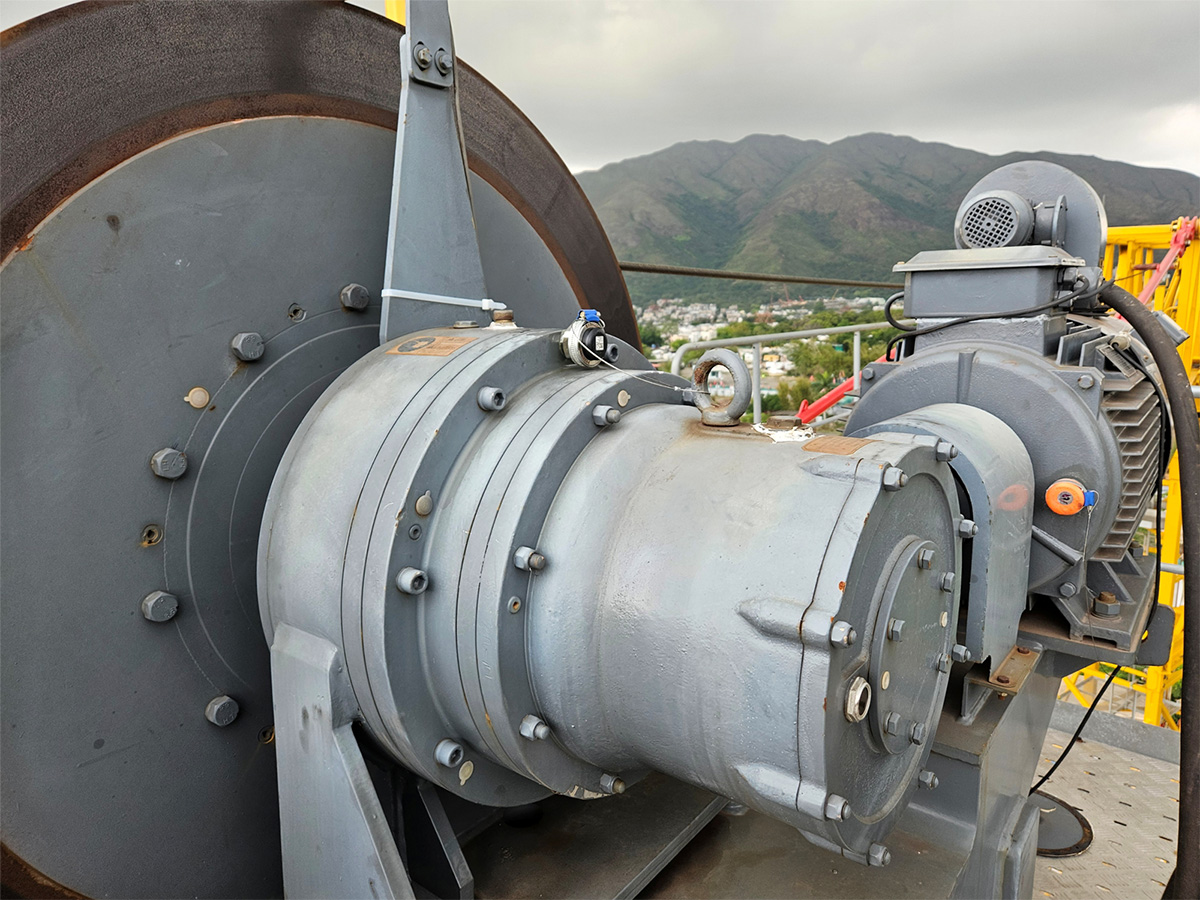
Project Scale & Technical Specifications
Assets Monitored
The system monitors one industrial-scale tower crane operating in a dense urban hub.
Hoisting Drive Unit: Powered by a 78kW MA180 M-E1 motor.
Slewing Drive Unit: Powered by a 0.12 kW motor.
Comprehensive oversight covers the Driving Motor, Gearbox, Drum (NDE), and the Slewing Ring.
Deployed Sensors
A strategic array of 6 sensors creates a multi-layered sensing environment.
Vibration Sensors: 2 High-Frequency and 2 Low-Frequency sensors distributed across hoisting and slewing units.
RPM Sensor: 1 Hall effect module to track hoisting drum speed.
Current Sensor: 1 CT module for electrical monitoring of the slewing unit.
Annual Data Collection
The system generates approximately 223,000 high-resolution datasets annually per crane.
Data is collected via 15-minute RMS updates and triggered 4-hour raw data sampling (25.6 kHz)
Installation Period
Plug & Sense mobile kit installed in 5 hours, causing minimal disruption
This was followed by a 3 week baseline calibration period
The Challenge
The Challenge
The project was initiated after the crane supplier identified abnormal vibrations specifically during lifting and turning maneuvers.
The primary concern was that these structural oscillations could signal underlying mechanical instability, threatening the structural integrity of the crane during critical high-load operations. The objective was to perform a deep-dive diagnostic to pinpoint the exact cause of the shaking and mitigate the risk of a catastrophic failure that could endanger site personnel.
The System
The System
01
Preventing Catastrophic Hazards
By monitoring the 78kW hoisting drive, XpiderWeb identifies early vibration patterns invisible to human perception. This prevents sudden motor or gearbox failures that could cause hundreds of tons of material to fall, directly mitigating the risk of site fatalities.
02
Zero Unplanned Downtime
The system delivers actionable lead time. In a real-world scenario, the AI detected gear wear 3 weeks before failure, allowing the client to replace the component in a single shift with zero delay to the project schedule.
03
Remote Intelligence
Operators gain real-time, 24/7 diagnostic access from anywhere. The system is designed to transmit automated alerts within 120 seconds of detecting an anomaly, ensuring rapid response.
04
Diagnostic Foresight
The solution moves beyond simple observation to data-driven Physical AI. It provides the "diagnostic foresight" necessary to ensure the crane's structural integrity is maintained even during the most demanding high-load operations.
The Results
Xpiderweb AI identified a high probability of gear misalignment within the drive system.
Gear
Gear Misalignment
Expert recommendation: replace the reduction gearbox and perform a complete system realignment.
Replace
Reduction gearbox replacement
Conclusion
Conclusion
Pinpointing the "Invisible" Instability
The initial monitoring quickly validated the supplier's concerns, transforming vague symptoms into precise mechanical data.Deep-Dive Diagnostics Based on the diagnostic data, the system identified a high probability of gear misalignment within the drive system. Crucially, the analysis pinpointed the location to the first and second stage gears inside the reduction gearbox, clarifying that the issue was internal rather than in the large slewing ring.
Actionable Resolution
With the root cause identified, XTRA Sensing provided a clear expert recommendation: replace the reduction gearbox and perform a complete system realignment. This decisive action resolved the structural oscillations, ensuring the crane could continue to operate safely in one of Asia's busiest construction environments.